Gears | (Manufacturing) Pressure angle
The pressure angle is a measure of the inclination of the tooth flanks. The pressure angle is equal to the profile angle αP of the generating straight-flanked rack. It is important to distinguish between the pressure angle as a parameter related to the manufacture of an individual gear (as addressed in this article) and the working pressure angle which is a parameter related to the gear mesh of working gears (see here).
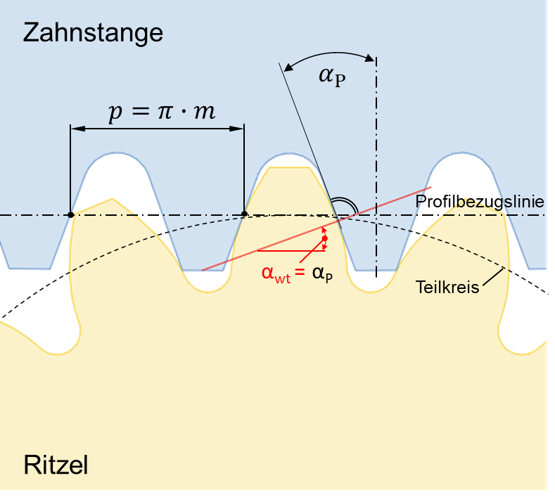
Fig. 1: Transverse section of the gear mesh between the gear and the generating rack (tool). In the special case illustrated here, the profile shift is zero (i.e., x=0), which is why the datum line rolls directly on the reference circle (datum line = generating working pitch line). The working pressure angle between the pinion and the tool profile (rack) is equal to the profile angle of the tool flank (αwt=αP).
For helical gears (β≠0), a distinction must generally be made between the pressure angle in the transverse plane αt and the normal plane αn. In the transverse section (index t), the pressure angle can also be interpreted as the working pressure angle between the gear wheel and the generating rack (see Fig. 1). The following relationship holds between the pressure angles in the transverse and normal planes:

A large pressure angle results in flat teeth with thin tips and thick roots, whereas a small pressure angle results in steeper teeth with thicker tips and narrower roots (see Fig. 2).
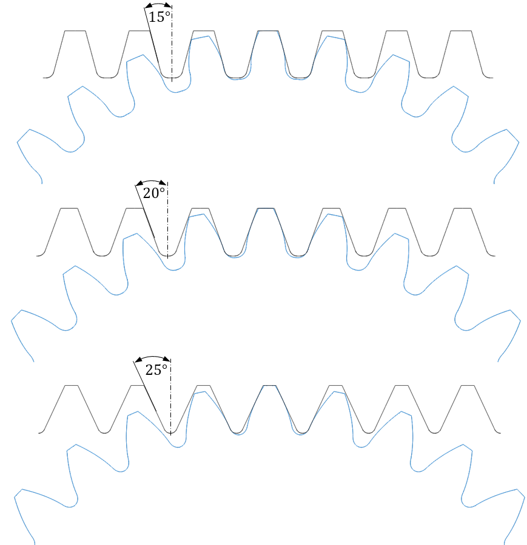
Fig. 2: Tooth shapes when manufactured with racks of the same tooth height but with different pressure angles.