Gears | Module
In English-speaking countries, instead of the module , often the diametral pitch Pd = z/d = 1/mt is used. For the diametral pitch in the normal plane Pnd the following identities hold: Pnd = 25.4/mn = Pd/cos(β), with mn in [mm] and Pd in [inch-1], and the helix angle β.
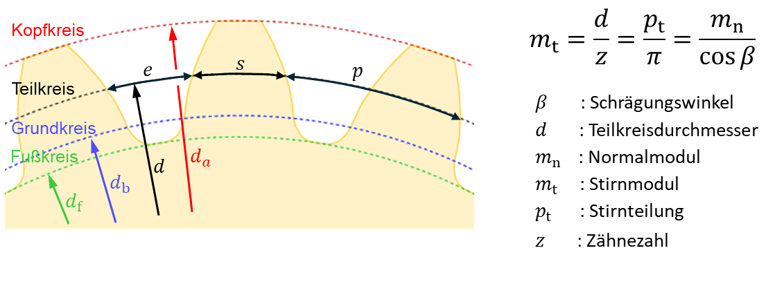
The module is among the most important gear dimensions for spur- and helical gears. The module represents the distance between the teeth, which is also referred to as the pitch. The pitch is the distance between two consecutive right or left flanks on the pitch circle (see figure). Even if the reference diameter d is a rational number, the pitch of the teeth in the circumferential direction is an irrational number (due to multiplication with π). Therefore, unlike in English-speaking countries, it is not the pitch (=d/z * π) that has become established as the standard parameter, but the module (=d/z). For helical gears (β≠0), a distinction must be made between the module in the transverse plane mt and the module in the normal plane mn. The module can also be regarded as a measure of the size of the gear's teeth, which is why gears with large or small teeth are also referred to as large-module or small-module gears. The tooth height is usually specified in relation to the module.